The Misdirection in a One-Line Joke
The misdirection in a one-line joke turns a plausible setup with one final phrase, helping you spot the hidden assumption and sharpen the comic turn.
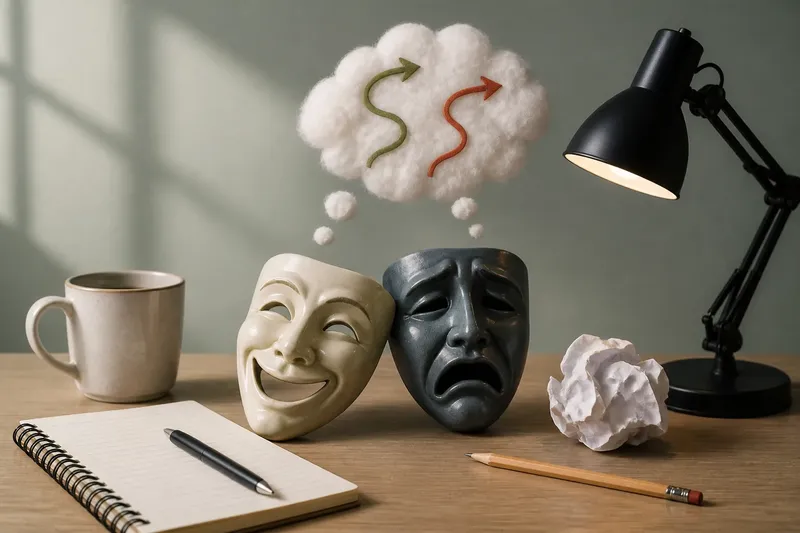
You hear, “I used to be indecisive, but now I’m not so sure.” The last phrase changes what the opening appeared to promise: instead of announcing a firm decision, the speaker circles back into uncertainty. The misdirection in a one-line joke depends on that small change of direction, made legible just as the line ends.
What makes misdirection work in a one-line joke?
A one-line joke gives the listener a plausible reading, then makes a later word or phrase favour a different one. The laugh often comes from recognising that both readings were available, even though the first seemed more likely as the sentence unfolded.
Think of the line as a short route with a turning point. Its opening supplies enough context for the audience to anticipate an ordinary finish; the punchline redirects that anticipation without making the preceding words meaningless.
This is different from simply adding a surprising phrase. If the ending has no clear connection to the setup, the listener may be startled but cannot easily see the joke’s construction. A satisfying turn lets the audience look back and find a reason the setup could carry both meanings.
How does a setup create the expectation?
The setup needs to point towards a familiar interpretation without spelling out the whole joke. It might suggest a common expression, a routine situation, a social role or a particular meaning of an ambiguous word. The audience uses that cue to guess what sort of ending belongs there.
For example, “I asked the librarian if the library had books on paranoia” starts a recognisable exchange about finding a book. A possible punchline, “She whispered, ‘They’re right behind you,’” turns the request into a joke about being watched. The invented line works because the request’s ordinary meaning stays understandable even as the whisper introduces another interpretation of “behind”.
To find a workable setup, write down what a listener is likely to assume at the point just before the turn. If you cannot name that assumption in plain language, the setup may be too vague, or it may be carrying several unrelated possibilities rather than one useful expectation.
Keep the setup economical, but do not strip out the clue the audience needs. A little context can establish who is speaking, what situation they are in and which meaning seems natural. The aim is not the shortest possible sentence; it is the smallest amount of information that makes the eventual turn clear.
What can a final word or phrase change?
The ending can redirect a line through a double meaning, a shift in reference, a changed assumption or a literal reading of an expression. In each case, the final wording gives the listener a reason to revise the meaning of something already heard.
- Double meaning: A word supports two familiar senses, and the punchline makes the less expected one relevant.
- Changed reference: A pronoun, name or description seems to refer to one thing, then the ending points towards another.
- Reversed assumption: The setup makes the speaker appear to be describing one situation, while the finish reveals a different motive or circumstance.
- Literal reading: An expression usually understood figuratively is treated as though its words were exact.
These are ways to inspect a draft, not boxes every joke must tick. A line can use more than one, but piling turns together often makes the listener work through the mechanics instead of seeing the comic change. A clean redirection usually has one main assumption to overturn.
How do you know whether the punchline is earned?
A punchline feels earned when it is both unexpected before the turn and understandable afterwards. The audience should be able to connect the ending to the setup without needing a new fact that the line never supplied.
Try reading the sentence in two passes. First, stop just before the final phrase and note the likely completion. Then read the whole line and ask what earlier word or assumption the ending changes. If there is no clear answer to the second question, the twist may be arbitrary; if the first answer gives away the ending, the setup may be too revealing.
Say you write, “My neighbour said he was great at keeping secrets, so I told him…” and finish with a phrase that reveals he immediately repeated the secret. The invented situation has a clear starting point, an action and an observable comic reversal: the neighbour’s claim is contradicted by what follows. If the ending instead introduces an unrelated accident, the line has surprise but no useful re-reading.
Also check whether the joke depends on a detail the audience could not reasonably infer. A punchline may use specialised knowledge or a specific reference, but the line should offer enough context for its intended audience to follow the turn. If the missing information is essential, add a cue or choose a more accessible route.
How can you make a one-line joke tighter?
Start by writing the setup and punchline in plain language, even if the result sounds clumsy. Identify the expected reading, then underline the word or phrase that makes the second reading possible. Keep the line’s other wording only when it helps establish the situation, guide the expectation or make the ending sound natural.
Next, try alternatives for the final phrase. A useful version does not merely announce the new meaning; it activates it with as little explanation as the line can comfortably carry. Read each draft aloud, because a phrase that looks brief on the page may be awkward to say, while a natural spoken rhythm can make the turn easier to catch.
Listen for the position of the turn. If too much material comes after the decisive word, the line may explain a surprise the audience has already understood. Move the revealing word towards the end where that sounds natural, but do not contort the sentence just to place it last. Clear syntax matters more than a mechanical final-word rule.
What is not worth the effort is replacing every ordinary word with an obscure pun merely to make the line cleverer. If the audience must pause to decode the vocabulary before it can recognise the changed assumption, the wording is obstructing the joke. Prefer the version whose second meaning is available quickly and whose phrasing still sounds like something a person might say.
What questions do writers ask about one-line misdirection?
Does every one-line joke need a double meaning?
No. A joke can redirect an assumption about a speaker, situation or expression without relying on one word with two dictionary meanings. What matters is that the ending gives the audience a coherent reason to reconsider the setup.
Should the punchline always be the final word?
No. The comic turn often lands near the end, but the strongest phrasing may require a short phrase after its revealing word. Let the sentence sound natural and avoid trailing explanation that only repeats the turn.
Why does a clever line sometimes get no laugh?
The expected reading may be too difficult to recognise, or the alternative may arrive before the audience has formed that expectation. The wording can also make the second reading hard to connect to the setup. Make the first interpretation easier to follow and the change easier to hear.
Can a one-line joke carry an idea as well as a laugh?
Yes. The redirection can expose an assumption about authority, work, family or everyday language, but the idea should be carried by the joke’s actual turn rather than added as an explanation afterwards. Ask what the line invites the listener to notice, and whether that meaning remains clear without a speech attached.
How does a misdirection joke change when spoken?
Performance controls when the listener receives each clue, but it cannot repair a turn that makes no sense on the page. In a spoken line, a brief pause may let the setup settle; careful emphasis can also make a key word audible without announcing that it is the punchline.
Keep delivery suited to the sentence. If the performer stresses the surprising word too heavily, the audience may predict that it is hiding a twist. If the line is rushed or swallowed, the second meaning may pass unnoticed. Read it in a conversational rhythm, then adjust only where clarity or timing needs it.
When working with another performer, agree on where the line turns and what the listener should be able to understand. The speaker need not telegraph the joke, and the listener need not react on cue. The useful shared decision is simply which words carry the setup and which words change its meaning.
How can you judge a revised line?
Return to the central question: does the last phrase make the opening look different in a way the audience can follow? The main phrase, misdirection in a one-line joke, describes a compact craft problem: create one likely reading, then redirect it with wording that also belongs in the sentence.
Keep a draft if its ending changes a specific assumption, its setup makes that assumption understandable and its phrasing needs no extra explanation. If one of those parts is missing, revise the part that is weak rather than adding more words to cover it. The final useful check is to read the line once without performing it: if the turn is still visible, the timing can support the joke instead of carrying it alone.